
Our paper on human infants’ helplessness (The evolution of human infants’ helplessness: Unique, relational, and long-lasting developmental implications) is out in the journal Child Development Perspectives and available here: https://academic.oup.com/cdpers/article/20/1/55/8414009
Humans are an unusual species – our babies are born uniquely helpless, with big consequences for childbirth and parenting, and growth and brain development. But in other ways, human babies are not quite as helpless as they first appear.
Our paper examines how human helplessness is unique, relational, and long-lasting. Unique in that humans differ from altricial (e.g., rats) and precocial (e.g., horses) species in the way that humans have relatively strong sensory systems, but weak motor systems. Relational in that human infants’ require care for others for a long time and early on and develop within these social contexts. Long-lasting in that elements of human immaturity persist later in the lifespan (for example, in the alignment of their spine and skull, both infant and adult humans look more like juvenile chimpanzees than adult chimpanzees).
Some older resources on human helplessness are below.
The infographics below were created in a 2022 University of Ottawa Directed Readings Course (PSY 4110) and draw on materials from the book Costly and Cute: Helpless Infants and Human Evolution (2016), edited by Wenda R. Trevathan and Karen R. Rosenberg.
Human helplessness and childbirth
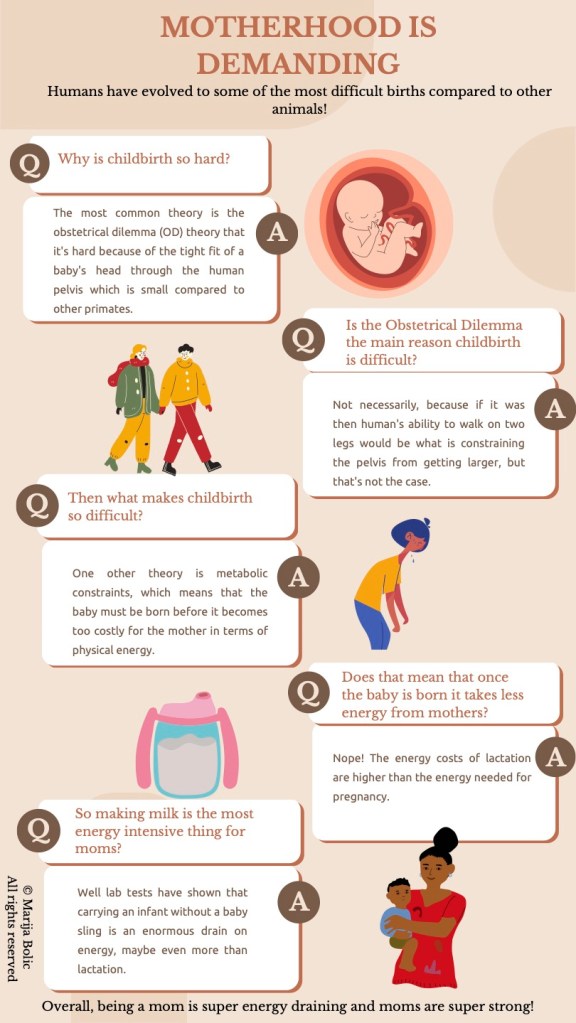
Motherhood is demanding.
Human mothers face challenging childbirths relative to other primate species. For more, see Dunsworth, H. M. (2016). The obstetrical dilemma unraveled. In W. R. Trevathan and K. R. Rosenberg (Eds.). Costly and cute (pp. 29-50). School for Advanced Research Press. as well as E.A. Quinn Infancy by design and D. Falk Baby the trendsetter in the same volume. Infographic by Marija Bolic, used with permission.
Human helplessness and brain growth
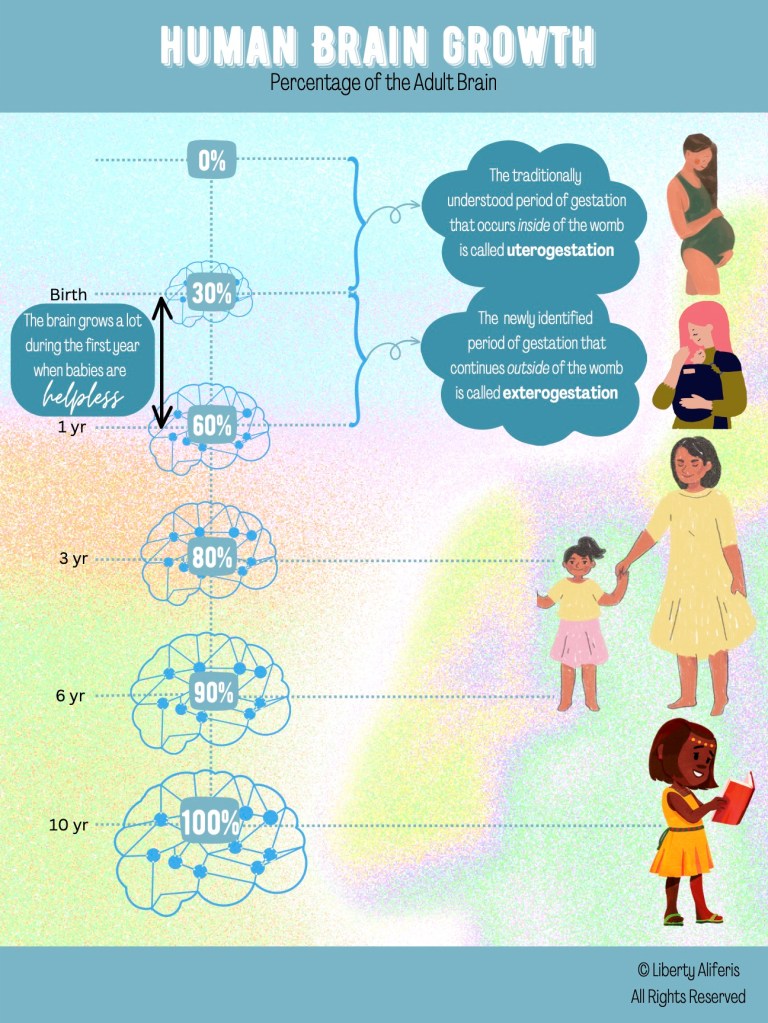
The human brain grows a lot in the first year of life.
The human brain keeps developing into our 20s, but the majority of its adult size is reached in the first year of life, a period when human babies are highly dependent on others. For more, see DeSilva, J. M. (2016). Brains, birth, bipedalism, and the mosaic evolution of the helpess human infant. In W. R. Trevathan and K. R. Rosenberg (Eds.). Costly and cute (pp. 67-86). School for Advanced Research Press. Infographic by Liberty Alferis, used with permission.
Human helplessness compared to other mammals.
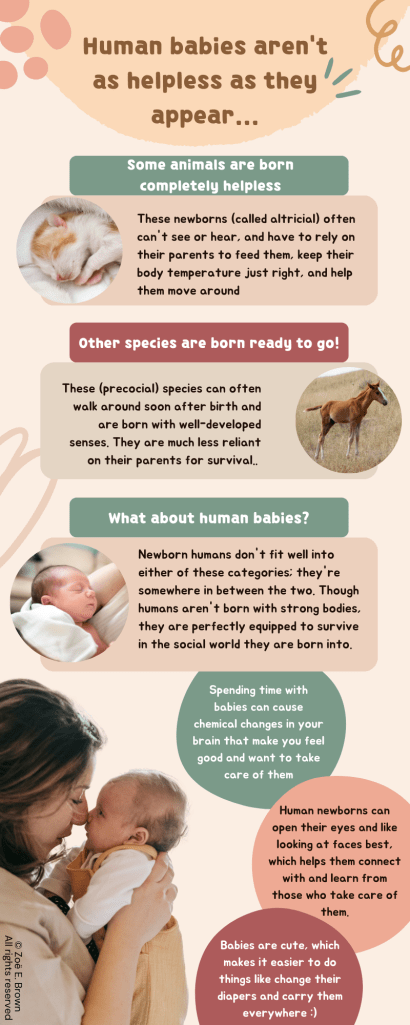
Humans babies are a different kind of helpless.
Human newborns are in some ways more similar to altricial species like cats or mice, but in other ways more like precocial species like horses. Overall, humans are helpless in a unique way! For more, see Trevathan, W. R. & Rosenberg, K. R. (2016). Human evolution and the helpless infant. In W. R. Trevathan and K. R. Rosenberg (Eds.). Costly and cute (pp. 1-28). School for Advanced Research Press. Infographic by Zoe Brown, used with permission.
 Dr. Stuart Hammond - Developmental Psychology - University of Ottawa